
advertisement
Ohio Voters Push Back Against The AI Data Center Boom

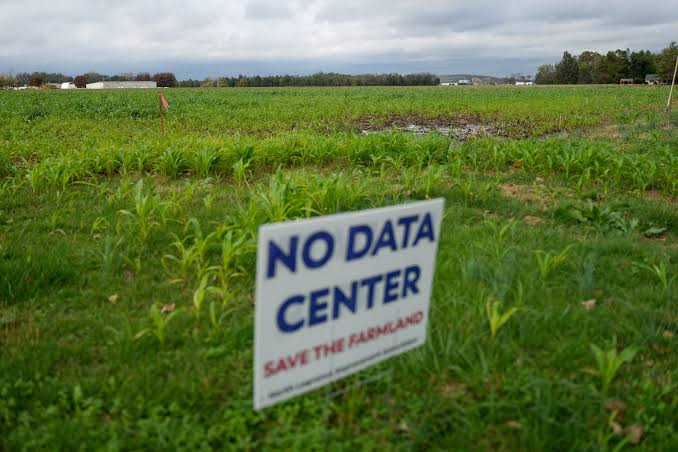
On Election Day, the AI infrastructure boom met the ballot box. In nearly every community where data centers were put to a vote, opposition prevailed.
The vote in Trenton wasn’t close. About 80 per cent of voters in the Butler County city backed a ban on large data centres, according to unofficial results reported by WVXU.
Trenton was among at least 14 Ohio municipalities that approved bans or new restrictions on November 3, in what emerged as one of the most concentrated local tests yet of public sentiment towards the infrastructure powering artificial intelligence.
advertisement
Ohio accounted for 21 of the 41 data centre measures on ballots nationwide, spread across 18 municipalities, Fortune reported. CNBC’s headline put the national result bluntly: voters rejected data centers in every ballot measure except one. Stateline reported that 33 local measures restricting data centers had passed or were leading late Tuesday, with North Dakota the only state where a result favoured the industry.
The number of measures varies by outlet, from 41 to 45. Results also remain unofficial until certified by county authorities.
What the votes did, and didn’t, do
advertisement
In Sunbury, voters appeared to approve a charter amendment banning data centers with capacity of 25 megawatts or more. The measure was aimed at a possible hyperscale Amazon project, although its future remains unclear. Pataskala approved a similar ban.
In Perry, more than 87 per cent of voters backed a requirement that developers seeking tax breaks provide financial guarantees. In Wilmington, about 80 per cent rejected proposals to rezone land for a data center across four referendums.
Some outcomes, however, may have limited practical effect.
advertisement
In Ashville, about 82 per cent of voters supported reversing the village’s agreement with EdgeConneX to build two data centers. But construction has already begun, and NBC4 reported that the vote would not stop the projects.
Trenton’s ban puts a 250-megawatt data center under construction in its industrial park in question. It does not affect a separate Amazon campus just outside the city. Trenton abandoned its bid to annex that land in September, the Cincinnati Enquirer reported.
Amazon declined to say whether the measures would change its plans, but said its commitment to host communities remained unchanged.
Why electricity bills matter
The public opposition is closely tied to household energy costs.
A Gallup survey in May found that about 70 per cent of Americans opposed having data centers in their local communities. A Heatmap poll published the week before the election found that rising electricity prices were the leading reason for opposition.
In PJM Interconnection, the grid operator serving 13 states from New Jersey to northern Illinois, capacity prices rose from $28.92 per megawatt-day in 2024-25 to $329.17 for 2026-27.
The grid’s independent market monitor estimated that data centers accounted for 63 per cent of the increase in the 2025-26 auction, adding $9.3 billion in charges, according to the Institute for Energy Economics and Financial Analysis (IEEFA).
IEEFA estimated that the increase would add about $16 a month to the average residential electricity bill in Ohio and $18 in western Maryland.
The extent to which data centers are responsible for higher bills remains contested. Brookings notes that experts disagree over how much of the increase should be attributed to data centers, compared with weather, infrastructure constraints and other factors.
“Ohio does not have a data center cost crisis,” the Ohio Manufacturers’ Association said.
The candidates
The debate also reached statewide and national races.
In Ohio’s Senate race, Democrat Sherrod Brown defeated Republican Senator Jon Husted. Brown campaigned on ending tax breaks for data centers and requiring companies to pay for the utility infrastructure their campuses need. He also called Husted “the face of data centers”.
Husted defended the tax incentives, citing their potential economic benefits.
In Michigan, NBC News projected Democrat Abdul El-Sayed as the winner. At a July event, he said, “People really effing hate data centers”, E&E News reported. His opponent, Mike Rogers, said in August that he supported a one-year moratorium.
Both candidates in Ohio’s governor’s race, Democrat Amy Acton, who won, and Republican Vivek Ramaswamy, proposed moratoriums. In Florida, Republican Byron Donalds, who won, proposed restrictions.
In Georgia, Democrats won both Public Service Commission seats, securing a 3-2 majority on the board that sets utility rates for the first time in about 30 years, according to Inside Climate News.
Peter Hubbard won by 12.8 percentage points, while Sheila Edwards won by 10.6 points.
Georgia Power customers have seen their monthly bills rise by about $44 across six increases since 2023. The costs of gas-fired power plants built to serve data centers have also been added to customer bills.
“The results show that people are very angry about data centers and climate emissions,” said Patty Durand of Georgians for Affordable Energy.
The industry’s money
The industry mounted its own campaign ahead of the votes.
Build American AI, which is linked to the Leading the Future super PAC, spent at least $2.54 million on television advertisements in Ohio promoting the economic benefits of data centers, DeSmog reported.
The advertisements cited $40 billion in investment and more than 95,000 jobs, although they did not endorse individual candidates.
AI-focused super PACs spent an estimated $72 million to $79 million nationally, depending on the tracker. Fortune reported that most of the Republicans they backed in competitive races lost, including Darline Graham in South Carolina, who received more than $4.8 million in support. Pete Ricketts won in Nebraska.
Democrats won both chambers of Congress, Gizmodo reported.
There is no evidence that opposition to data centers alone determined the outcome of any of the races. Goldman Sachs strategists, Fortune reported, believe a Democratic-controlled Congress could restrict data center tax incentives but consider a nationwide moratorium unlikely.
Meanwhile, the industry’s expansion continues. Reuters reports that data center capacity under construction has increased by 48 per cent nationwide.
Ohio state data show that up to $40 billion in AI infrastructure investment is planned by 2030. The state already has more than 200 operating data centers and 125 local moratoriums.