
advertisement
CIO100 Opens In Diani With Call for Africa to Turn AI Adoption Into Competitive Advantage


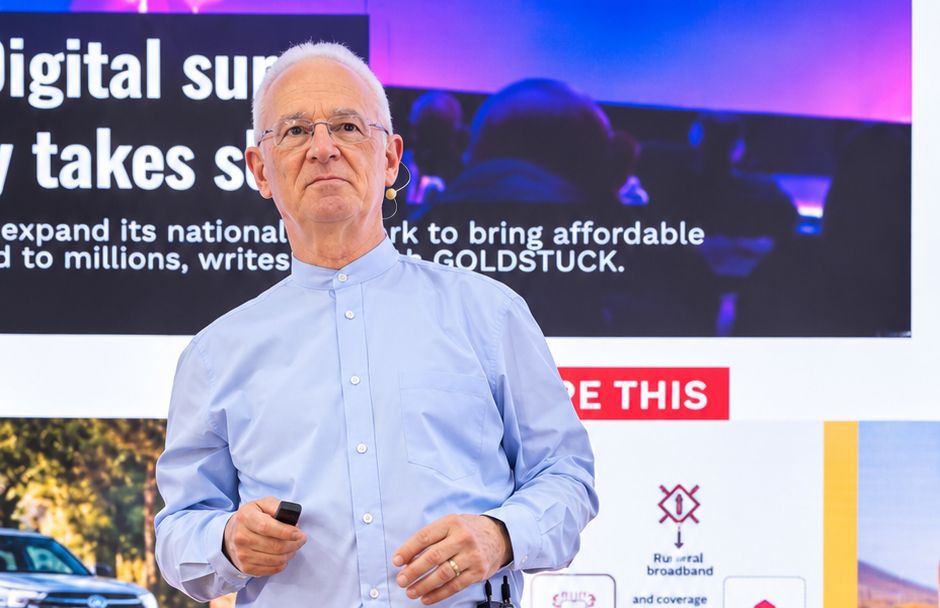
Africa must move beyond consuming artificial intelligence developed elsewhere and turn its homegrown innovations, local knowledge and experience solving difficult problems into a competitive advantage in the global technology economy.
That was the central message from Arthur Goldstuck, CEO of World Wide Worx, author and journalist, who delivered the opening keynote at the CIO100 Symposium and Awards 2026 in Diani on Wednesday.
In a presentation titled The African Edge: From AI Adoption to African Advantage, Goldstuck argued that Africa’s constraints have often forced businesses and innovators to develop solutions that can offer lessons to the rest of the world.
advertisement
He cited Kenya’s M-Pesa as a defining example of an African innovation that emerged to address local market needs before influencing mobile money services globally.
He also highlighted agricultural technology platforms, local-language language models and payment systems as evidence that the continent is capable of developing technology rather than simply importing it.
Goldstuck pointed to Egranary, which he said serves 25,000 small-scale farmers through banking, financing and crop sales. He also referenced Nairobi-based Intellipro, founded by Anida Mutuku more than a decade ago, as an example of Kenyan innovation emerging before artificial intelligence became a mainstream business conversation.
advertisement
“On this continent we face constraints and challenges. And we use technology within those constraints to address those challenges,” he said.
For Goldstuck, the African edge lies in the ability to innovate despite constraints, or sometimes because of them. He argued that this experience can position African businesses as contributors to global technology development.
But he cautioned that access to technology alone does not guarantee a competitive advantage. How organisations deploy it, build trust around it and integrate it into their cultures will determine whether AI investments deliver measurable results.
Trust is the real differentiator
Goldstuck used Germany’s 7-1 victory over Brazil in the 2014 FIFA World Cup semi-final to illustrate the relationship between technology and trust.
Germany had worked with SAP to develop SAP Sports One, a real-time data analytics platform that helped the national team analyse player and team performance.
The system demonstrated how data could support better decisions, but Goldstuck argued that the decisive factor was the trust between people, technology and partners.
“The real secret of that victory was trust. It wasn’t tech, it was trust,” he said.
He challenged CIOs to build trust into AI deployments from the beginning rather than introduce systems and expect employees and customers to accept them afterwards.
He reinforced the point with examples from Spain’s LaLiga and Ireland’s national rugby team.
LaLiga had used advanced technology in video assistant refereeing, match planning and player management. Goldstuck said Spanish clubs dominated European football competitions between 2008 and 2018, occupying 25 of the 40 available semi-final places. English clubs occupied 13.
However, as other leagues adopted similar technologies, the balance shifted. In the following seven years, English clubs occupied 20 semi-final places, compared with eight for Spanish clubs.
The lesson, he said, was that technology eventually becomes less of a differentiator when competitors gain access to the same capabilities.
He also cited Ireland’s use of AI-powered player tracking, developed by Irish startup Stats Sports, to measure individual performance and inform coaching decisions. The technology allows coaches to compare players’ performances against historical data and make more informed decisions on substitutions and workloads.
Goldstuck stressed, however, that data should inform decisions rather than replace human judgement.
Drawing on examples from rugby and football, including South African coach Rassie Erasmus and Kenya’s Benni McCarthy, he argued that experience, tactical awareness and leadership remain essential.
AI adoption is not translating into productivity
Goldstuck warned that businesses could be adopting AI at scale without achieving corresponding productivity improvements.
Referencing the South African AI Index 2026, a World Wide Worx research project, he said 96 per cent of companies were using generative AI, but only 51 per cent were reporting productivity results.
He attributed the gap partly to organisations failing to embed AI into their cultures and build trust around its use.
For CIOs, the challenge is therefore to move beyond measuring AI adoption and demonstrate how the technology improves business performance.
He also warned that AI tools were making it easier to forge documents, identities and videos, creating new risks for businesses and their customers.
“Verification becomes part of your product,” he said.
The warning points to a growing responsibility for technology leaders to strengthen verification processes as synthetic content and AI-enabled fraud become more sophisticated.
Agentic AI raises the accountability bar
Goldstuck said the emergence of agentic AI would introduce a more complicated governance challenge as systems move from providing recommendations to taking actions independently.
“Until now, AI advised and investors decided. But agentic AI, AI acts for itself and you have to decide who authorised its action,” he said.
He argued that every AI-driven action must be traceable, explainable and reversible, with controls operating in real time.
The shift raises important questions for CIOs about who authorises autonomous systems, who remains accountable when they make mistakes and how organisations can intervene when automated decisions go wrong.
Goldstuck’s message was that AI governance must be built into deployment before systems are given authority to act.
He challenged delegates to assess their own AI readiness, including how frequently they use AI for actual work and whether their organisations have the culture and capabilities to benefit from it.
CIOs urged to prepare for the CEO role
Earlier, opening the symposium, Harry Hare, Chairman and Co-Founder of CIO Africa by dx5, challenged technology leaders to rethink the changing responsibilities of the CIO and consider the possibility of moving into chief executive positions.
Hare said the CIO role had become increasingly complicated, with organisations expecting technology leaders to oversee cybersecurity, talent, IT costs and the technology decisions shaping business strategy.
He argued that CIOs had a unique view of organisational operations because businesses increasingly depend on systems to function.
“Businesses are run on systems. And who runs the system?” he asked.
Hare pointed to the movement of two Kenyan technology executives into top leadership positions, including Dr Kamande, formerly CIO at Nairobi Hospital and now its CEO, and a former CIO at the National Transport and Safety Authority who became its Director General.
He challenged delegates to consider whether their career ambitions should extend beyond the CIO position.
“Should I be planning my exit from the CIO into CEO? Just a thought,” he said.
Hare also urged participants to use the symposium as a peer-learning platform, asking presenters difficult questions about the technology projects drawn from the CIO100 survey.
The 2026 gathering, running from November 25 to 27 at Diamonds Leisure Beach and Golf Resort, is themed Innovation at Scale: Driving Business Growth Through IT Leadership.
It brings together more than 800 technology leaders from over 10 African countries across three stages: Arena for leadership discussions, Matrix for technical sessions and Nexus for sector-specific case studies.
The programme will cover banking and fintech, healthcare, insurance, government, telecommunications, manufacturing and education, alongside discussions on AI, cybersecurity, digital infrastructure and enterprise transformation.
The symposium will conclude on Friday with the CIO of the Year Gala Awards Dinner, where the overall winner and regional CIO of the Year recipients for East, West, North and Southern Africa will be announced.