
advertisement
Data Centre Power Demand Is Reshaping Digital Infrastructure Investment

For years, data centre development revolved around finding suitable sites, securing customers and deploying computing infrastructure. As artificial intelligence workloads grow, however, access to reliable electricity is increasingly determining where facilities can be built, how quickly they can become operational and how much they cost to run.
AI training clusters and high-density GPU racks consume substantially more power than many traditional enterprise workloads. At the same time, grid connection delays are making it harder for operators to bring new capacity online on schedule. The result is a shift in data centre investment, with power generation, energy storage and intelligent power management becoming central to infrastructure planning rather than secondary considerations.
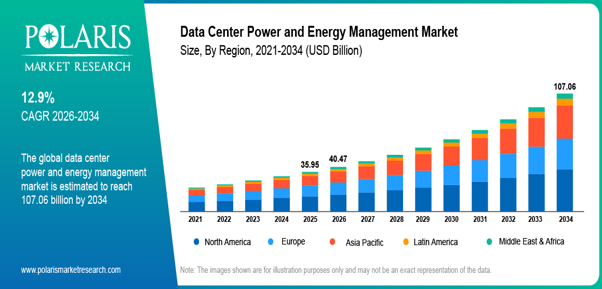
Polaris Market Research valued the global data centre power and energy management market at US$35.95 billion in 2025 and projects it will reach US$107.06 billion by 2034, representing a compound annual growth rate of 12.9%. The projected expansion reflects a broader change in the economics of digital infrastructure: the ability to secure and manage electricity is becoming as important as the ability to deploy computing capacity.
advertisement
For operators, this changes the order in which investment decisions are made. Instead of designing a facility around its computing requirements and subsequently addressing its power needs, developers increasingly have to consider electricity availability, generation options, storage capacity and distribution systems from the outset.
The shift is particularly important as AI workloads increase the amount of electricity required by individual racks. Traditional power distribution systems may not be sufficient to support these densities without upgrades to uninterruptible power supply (UPS) systems, switchgear and rack-level power distribution units. Monitoring systems are also becoming more important as operators seek to prevent overloads, manage demand and keep expensive computing equipment in productive use.
These requirements create opportunities for equipment manufacturers and energy management software providers, but they also raise the cost and complexity of developing new facilities. Power architecture must accommodate current workloads while allowing for future increases in computing density, without requiring expensive and disruptive reconstruction.
advertisement
On-site power moves from backup to strategic infrastructure
Grid constraints are creating another challenge. Where utility connections cannot be delivered quickly enough, operators are exploring alternatives including gas-powered generators, solar installations, fuel cells, battery storage and microgrids. These systems can provide backup, supplement grid electricity or, in some circumstances, supply power while operators wait for additional utility capacity.
This is changing the role of on-site generation. Historically, generators and backup batteries were primarily intended to keep facilities running during outages. Increasingly, they are being considered as part of the infrastructure required to bring capacity online and manage electricity demand.
advertisement
Polaris projects energy generation to be the fastest-growing solution segment in the market, with a compound annual growth rate of 13.5% through 2034. The projection points to growing interest in technologies that give operators greater control over when and how electricity is supplied.
Battery storage could also help manage fluctuations in demand from AI workloads, while microgrid controls can coordinate multiple energy sources. Fuel cells offer another option for operators seeking additional generation capacity, although their suitability depends on factors including fuel availability, costs and the requirements of individual sites.
These technologies do not eliminate the need for grid infrastructure. Their commercial value depends on the cost of electricity, the reliability of alternative supplies, the time required to deploy them and the extent to which they can meet a facility’s continuous power requirements.
For data centre developers, the central calculation is increasingly about the total cost and availability of power over the life of a facility, rather than electricity tariffs alone.
Power management is becoming a business decision
The implications vary across the data centre industry. Hyperscale operators held 37.33% of the global market in 2025, according to Polaris. Their scale gives them a strong incentive to plan power infrastructure alongside computing capacity, particularly because electricity costs and infrastructure utilisation can affect operating margins across large campuses.
For these operators, software that forecasts demand, monitors consumption and optimises power distribution can help identify unused capacity and inform investment decisions. Predictive analytics and digital twins can also be used to model infrastructure requirements before operators commit capital to new equipment or facility upgrades.
Colocation providers face a related but distinct challenge. They sell space, connectivity and power capacity to customers, making the amount of electricity available within a facility directly relevant to their commercial proposition.
Rack-level metering helps providers understand consumption and allocate capacity, while modular UPS systems allow them to expand protected power capacity in stages. Polaris projects the colocation segment to grow at 12.7% annually.
The ability to add capacity within existing facilities could be valuable where land, grid connections or construction timelines limit expansion. However, modular equipment does not automatically resolve constraints involving the wider electrical supply, cooling infrastructure or the capacity of existing buildings.
Software and services are therefore becoming more important alongside physical equipment. Operators need to coordinate power distribution, backup systems, generation and computing demand, while ensuring that new monitoring capabilities integrate with existing infrastructure.
That integration comes with risks. Advanced power systems can require substantial upfront investment, while retrofitting operational facilities introduces technical complexity and potential disruption. Connected equipment also creates cybersecurity considerations, particularly as monitoring and control systems become more integrated with facility management networks.
Regional markets face different versions of the same problem
North America accounted for 38.58% of the global market in 2025, representing approximately US$13.87 billion, according to Polaris. In the United States, growing data centre electricity demand has intensified concerns about whether power infrastructure can keep pace with new development.
The US Department of Energy has projected that data centres could consume between 9.5% and 15.3% of the country’s electricity by 2030. The range reflects uncertainty around the pace of AI adoption and future infrastructure demand, but both ends of the forecast point to the growing importance of power planning.
Europe faces a combination of grid constraints and regulatory pressure. Polaris projects the regional market to grow at 12.3% annually, reaching US$27.7 billion by 2034. Energy efficiency reporting is also becoming more prominent. In April 2026, the European Commission published aggregated reporting data covering 776 data centres across 18 member states, with a weighted average power usage effectiveness (PUE) of 1.36.
PUE measures total facility energy use relative to the energy consumed by IT equipment. Although it does not capture every aspect of environmental performance, its use in reporting illustrates how energy efficiency is becoming more measurable and open to comparison.
Asia Pacific is projected to grow at 14.6% annually, with the regional market reaching US$30.2 billion by 2034. Expanding digital infrastructure in markets including China, India, Japan and Australia is increasing demand for power equipment and management systems.
The Middle East and Africa market is projected to grow at 13.6%. In parts of the Middle East, high temperatures increase the importance of efficient infrastructure, while solar resources create opportunities for renewable energy. Across Africa, the challenge varies considerably by country and location. Unreliable electricity supply, limited grid capacity and the cost of securing dependable power can make backup generation and alternative energy sources important considerations for data centre projects.
For African operators, however, the investment case cannot be separated from local conditions. The availability of renewable resources does not by itself guarantee reliable, affordable power. Projects must also account for grid access, transmission infrastructure, financing, equipment costs and the availability of technical expertise.
These constraints can influence where new facilities are developed and how quickly they can expand. They may also create opportunities for energy storage, solar generation and microgrids, particularly where such systems can complement existing electricity infrastructure.
The experience of mature data centre markets offers useful lessons, but their solutions cannot simply be transferred across African markets without considering differences in electricity systems, financing conditions and customer demand.
Equipment suppliers are competing on integration
Competition in the power management market is increasingly focused on combining electrical infrastructure, software, cooling and alternative generation rather than supplying individual components.
Schneider Electric has partnered with AMD on a validated reference design for racks rated at up to 246 kW and introduced software-defined medium-voltage switchgear, with orders expected from 2027. ABB has launched a direct-current portfolio for AI facilities, claiming efficiency gains of more than 5%.
Corporate acquisitions also indicate that suppliers want to address a wider share of the infrastructure challenge. Eaton acquired Boyd Thermal for US$9.5 billion, bringing liquid cooling capabilities into its portfolio. Vertiv agreed to acquire UtilityInnovation Group for approximately US$1.45 billion, expanding its capabilities in microgrid controls and behind-the-meter power infrastructure. Generac is acquiring Enercon, which supplies switchgear and enclosures.
The developments point to a market in which power, cooling and control systems are becoming more closely linked. As computing densities rise, decisions about electricity distribution affect cooling requirements, while the performance of cooling systems influences the total energy needed to operate a facility.
On-site generation is attracting investment as well. Bloom Energy expanded its partnership with Oracle to as much as 2.8 GW of fuel cell capacity, of which 1.2 GW was contracted. Cummins has also announced a battery storage system for a US data centre that it described as its largest.
These developments suggest that suppliers increasingly see data centre power as a broader infrastructure market encompassing generation, distribution, storage, monitoring and control.
The next phase will depend on cost and deployment speed
Several technologies could influence how operators respond to rising demand. High-voltage direct-current distribution is being explored as a way to reduce the number of power conversion stages in some data centre designs. Battery storage is already commercially available, while microgrid controls can help coordinate electricity from different sources.
Their adoption will depend on whether the benefits justify the costs and whether the technologies can be integrated into facilities with different technical requirements. New designs may be easier to implement in greenfield developments, while existing facilities must balance upgrades against the cost and complexity of working around operational infrastructure.
Uncertainty around AI demand adds another complication. If computing requirements rise faster than expected, operators could face renewed pressure to secure electricity and expand capacity. If demand grows more slowly, investments in generation and electrical infrastructure could take longer to deliver the expected returns.
Cybersecurity will remain part of the equation as power management becomes more connected. Systems that monitor or control electricity supply must be protected against unauthorised access and disruption, particularly where failures could affect the availability of critical digital services.
For African markets, the strategic question is how to expand data centre capacity without allowing electricity constraints to undermine the economics of investment. Reliable power, efficient infrastructure and access to capital will all influence the ability of operators to meet growing demand from cloud services, enterprise computing and AI.
The broader change is that electricity is no longer simply an operating expense to be managed after a data centre has been built. It is a core design and investment consideration that shapes site selection, construction timelines, operating costs and expansion plans.
As AI workloads increase the pressure on existing infrastructure, the operators best positioned to grow will be those that plan computing capacity and power supply together. In an industry increasingly constrained by electricity availability, the ability to secure, distribute and manage power may determine how quickly digital infrastructure can expand.