
advertisement
Judiciary Set To Launch AI Adoption Policy Framework


Lawyers have confidently cited imaginary cases from a hallucinating AI. It’s great for laughs and that OMG smack on the forehead when we all go, ‘what were they (not) thinking?’ It feels frequent, but this has only happened a grand total of seven times in Kenyan courts. Thankfully, none of the case law was used to arrive at a judgment.
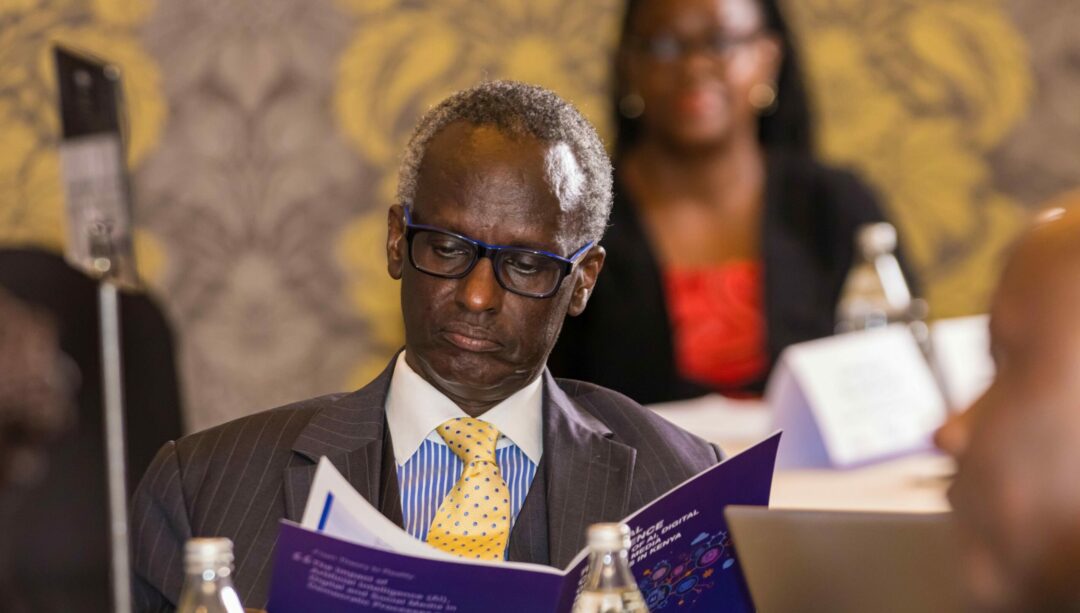
With AI infiltrating humanity the past few years, it was only a matter of time before it became an inevitability. And with that has arisen the need to design a frame to hold up the liquid nature of AI in the judiciary. Kenya has stepped up, and will be launching their AI Adoption Policy Framework, said Justice Isaac Lenaola at the Ai Everything Kenya x GITEX Kenya summit.
“Our silver lining was COVID. It threw us into the deep end of technology, and suddenly we had no choice. We had been slightly sluggish in adopting technology. Between 2020 and today, we have made steps to integrate technology into our processes.” This has involved digitilisation, going paperless through an ERP, and a pilot transcription system.
advertisement
The court stenographer does not exist in Kenyan courts. Instead, the judge and magistrates record proceedings themselves. This aspect of toiling away will now be replaced with AI. Transcription happens overnight. The next day, humans descend upon the copy, filling in the gaps resulting from a swathe of local accents. The pilot has been so encouraging, “We now intend to launch the Judicial International Transcription Center,” said the Justice.
The judiciary also incorporated a chatbot to interact with the public.
They also intend to launch Hakimu.ai (it means judge/magistrate in Swahili). It will be linked to and synched with the judiciary’s portal where all cases will be deposited, making it the fastest tool of legal research.
advertisement
Moving at such a quick trot, however, has meant the judicial ecosystem needs a refresh. There has been significant integration with the Office of the Director of Public Prosecutions (ODPP). Meanwhile, the National Council on the Administration of Justice (NCAJ)is collaborating to onboard the police, prisons, probation, and the children’s department. “I realise the judiciary is moving a lot faster than the other agencies. Over the past three years, we have had a number of meetings to bring everyone along.” This involves designing for interoperability such that all systems across agencies form part of a unified judicial system. The Office of the DPP, for instance, are plugged in through Uadilifu, a case management system.
While AI is intelligent, it is also prone to judicial hallucinations, and chatbots could spit out fake research, influencing judgments. “Yes, that is a real risk, but the bigger risk is to us. I’m very careful about this. Can you imagine if the Supreme Court of Kenya, being the final court in the land, cites an article from AI research, and then we find out that we were wrong? How can we stand in public?”
Enter the Judiciary AI Policy Framework.
advertisement
“Tomorrow, we are going to validate the AI policy for the judiciary and also validate the practice directions for use of AI in the profession.”
The policy creation further emanates from a tour of Brazil, Israel and India.
Brazil, with its backlogged cases hitting a formidable 80 million, has a binding resolution, a dedicated oversight committee, a risk classification system, a shared AI platform (Sinapses), and a live legislative process for a national AI Act.
Israel, on the other hand, has a soft-law approach. It has a national AI ethics and regulation policy that involves the Ministry of Justice as a co-author, and a pilot is underway for AI in criminal sentencing. No dedicated standalone judiciary AI policy framework (governing how courts use, oversee, or constrain AI in judicial proceedings), yet.
India’s case is driven largely by the sheer scale of its backlog with well over 50+ million pending cases. So far, AI governance is still fragmented: strong at the Supreme Court level, pioneering at the Kerala High Court level, and thin everywhere else. There is the 2025 Supreme Court White Paper, the closest thing to a judiciary-specific AI framework. It acts more as a guide, than a law.
“We are learning from them that the issues we are raising are issues we are addressing in our policy and in our practice relations. We are aware of the risks. And that is the beauty of our strategy in our work. We are running fast because we have the positive innovation from others who have suffered the difficulties encountered at the beginning of the technology. We are running from the top and we are heading somewhere.”
A February 2026 survey of Justice Lenaola’s colleagues indicated that 43.6 per cent of respondents said they used AI, but they hated it. It just made the task riskier. But, 72.6 per cent say they fear to use AI because of hallucinations. “We need to get out of this fear of syndrome. We need to move forward and embrace the ability to use AI and address decisions of the government. We are alive to the fact that there is no choice.”