
advertisement
Kenya Rallies Africa To Build Its Digital Future At Connected Africa Summit


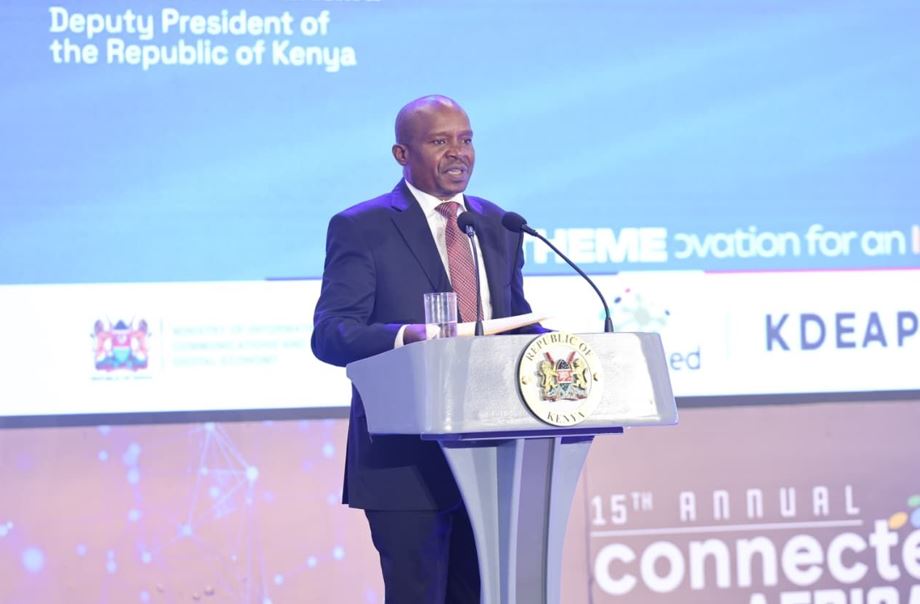
Opening the Connected Africa Summit 2026 in Nairobi, Prof Kithure Kindiki, Kenya’s Deputy President, challenged African countries to place technology and digital infrastructure at the centre of national development strategies, noting that technological advancement remains the most powerful driver of economic growth and governance transformation.
“The digital future of Africa will not be handed to us. We must build it boldly, patiently, strategically and deliberately together. Technological advancement is the biggest driver of the future,” said the Deputy President.
He added that Africa is at a defining moment in its digital journey and must move beyond dialogue to practical implementation and continental collaboration.
advertisement
“Africa is ready to shape its own digital future. Africa is ready to build together. Africa is ready to move from conversation to execution—from pilots to a Pan-African reality,” he said.
The Deputy President highlighted several transformative investments Kenya has made in recent years to strengthen its digital ecosystem and expand access to digital services across the country.
Among the initiatives is the expansion of the Digital Superhighway, with an additional 30,000 kilometres of fibre optic infrastructure deployed and a long-term target of 100,000 kilometres. The government is also establishing ICT hubs in each of Kenya’s 1,450 wards, with 382 already completed and more than 400 nearing completion. Public Wi-Fi hotspots have also been rolled out nationwide, while thousands of young people are benefiting from digital skills training programmes aimed at preparing them for opportunities in the digital economy.
advertisement
The Deputy President was accompanied by senior government leaders including William Kabogo, Cabinet Secretary for the Ministry of Information, Communications and the Digital Economy; John Tanui, Principal Secretary for ICT and the Digital Economy; Jessy Kiveu Maruti, Chief Executive Officer of the Information and Communications Technology Authority; and Rebecca Miano, Cabinet Secretary for Tourism and Wildlife.
Organised by the Information and Communications Technology Authority, the four-day summit has brought together policymakers, innovators, development partners and private sector leaders from across Africa.
Held under the theme “Uniting Africa’s Innovation for an Inclusive Digital Market,” the summit seeks to accelerate measurable digital transformation through collaboration, policy alignment and investment in enabling infrastructure.
advertisement
The opening day featured high-level dialogues involving ministers, regulators and industry leaders, including sessions on Digital Public Infrastructure as Africa’s Engine for Inclusive Digital Transformation and AI for Africa: From Adoption to Global Leadership.
During the ministerial session, leaders from across Africa emphasised the need for stronger collaboration, regulatory alignment and investment in digital infrastructure to unlock the continent’s digital potential.
Shadric Namalomba, Malawi’s Minister of Information and Communications Technology, underscored the importance of restructuring funding models to reduce dependence on foreign financing and promote local funding mechanisms. He also called for enabling regulatory frameworks, interoperable digital systems across Africa, and greater investment in digital literacy.
From South Sudan, Ateny Wek Ateny highlighted the country’s progress in strengthening its digital governance framework, including the development of a Cybercrime and Abuse Act in 2025 and plans to establish an ICT Authority and Data Protection Act. He emphasised the importance of regional integration within the East African Community to accelerate digital transformation.
Chris Baryomunsi, Uganda’s Minister of ICT and National Guidance, noted that digital transformation is an urgent priority for African economies. He stressed the importance of regional cooperation to strengthen connectivity and develop a functional digital ecosystem across the East African region.
Also speaking at the summit, Deemah AlYahya, Secretary-General of the Digital Cooperation Organization, highlighted the importance of technology sovereignty and interoperable digital systems that enable seamless cross-border services. She said Africa’s digital economy has the potential to grow from USD 20 billion to USD 70 billion by 2031 if countries work collectively to reduce fragmentation across the continent.
Qimiao Fan, Country Director at the World Bank, called for policy harmonisation across African countries to unlock greater investment in digital infrastructure. He also emphasised the importance of public-private partnerships and investment in digital skills to empower young people to participate fully in the digital economy.
The Connected Africa Summit continues throughout the week with discussions focused on advancing digital public infrastructure, strengthening regional digital markets and positioning Africa as a global leader in innovation and technology.