
advertisement
When Implementation And Infrastructure Meet Africa’s AI Moment



There are two ways to lay fibre optic cable.
The first is the prescribed standard: dig, bury the cable underground by land, so that when the road crews come through — and they will — the fibre survives, or by sea. We are familiar with it. One day, the earth is suddenly churned in your neighbourhood, trenches framed with rubble running parallel to your path, silt mixing with tarmac if it pours. Or, sometimes, the odd fibre cuts a rug right across the road. The second way is faster, cheaper and above ground: string it in the air, on poles, on trees, and lace it with a dollop of hope.
Both methods deliver connectivity from day one, but only one is still delivering it in year five. “You can still string fibre in the air, on trees and get the same output. But you’re compromising on availability and reliability. Yes, it’s fast to do it on a tree, but it’ll be more costly in the future in maintenance, reliability, and customer satisfaction.”
advertisement
And that is how an engineer thinks about infrastructure and policy. It is also, Wamola will state, how a continent should think about digital transformation, yet too often, doesn’t. Yes, we know Africa has never lacked ambition. The policies exist. The strategies, laid out. The summits, annual. Missing, however? Implementation. The will to execute. As Head of Africa at the GSMA, the global body representing 800+ mobile network operators, Wamola sits at the precariously challenging yet exciting nexus between operators and regulators, investors and ministries, the networks that exist and the 960 million Africans under their coverage but have yet to go online. The stakes, cliched as this will sound, have never been higher. Because AI will not keep.
A Glimpse Through The Engineering Lens
Wamola’s route to policy is atypical. African regulators and policymakers come wielding law degrees more often than not. She approaches it as an engineer. Six years in Safaricom’s technology division as the first and only senior woman in its leadership, she literally planned and run the networks we angsted over every Friday evening with our peculiar habits, savoured, then took for granted over time; bars on a phone screen. “Having the engineering background, and having worked with a mobile network in the technology division, you get to really understand how a service is delivered. And that helps you appreciate the constraints. Because at the end of the day, the service is costed.”
Every infusion into a network, from the licence to the diesel in the generator, ends up somewhere in the price a customer pays for a gigabyte of data. So does every policy decision. Take licensing. When a licence is tied to a specific technology, an operator pays twice for every generational upgrade: once for the real engineering work of new equipment on the towers, and again for a fresh licence, often hundreds of millions of dollars, just for permission to use the new technology, even on kit they already own. The undercurrent cost repeats with every leap from 3G to 4G to 5G, a double whammy flowing through to the price of data. “With technology-neutral licensing, it doesn’t matter whether I use satellite, fibre, 3G or 5G. You just get one licence, and it makes it cheaper.”
advertisement
Narrowing the coverage gap tower by tower, cable by cable to roughly nine per cent of the population living beyond the reach of 3G-and-above networks, coverage almost seems like the easy problem. “When you look at the usage gap (people who have access to the technology but are not using it), then we start looking at other barriers,” she says. Digital literacy. Device affordability. The absence of content in languages people actually speak. Close to a billion people stand on the paradox of an inactive side of that line: covered, but offline. Those people are your unbanked customers, unreachable citizens, digital channel users and everyone you build for but are just out of reach.

Making It Make Sense
When looking at African digital transformation as a whole system, Wamola identifies the point of failure not as spectrum, or fibre, or even skills. Instead, she says, it was narrative. “It’s in making it make sense. Digital transformation means you’re moving from something to something. From analogue to digital, from obsolete technology to new technology. It means there will need to be a business case. And making it make sense means somebody, at the end of the day, will pay for it. Because nothing comes for free.”
advertisement
That failure compounds. Africa has not made the case convincingly enough to investors, who must keep capital flowing into a brutally capital-intensive sector. Nor to customers, who somehow believe connectivity is exempt from economics. “In all the other sectors, prices are going up — fuel, food, school fees, hospital costs. The mobile industry is the only sector where the expectation from customers is that the price should go down. Does that make sense? The same fuel that runs your network went up in price, but somehow the data price should go down. The data ran on fuel. The data ran on a network.”
A network under repeated assault. “Before, people were stealing copper. Now they’re stealing solar panels.” The panels installed to make rural sites sustainable. Each stolen battery, each severed cable, is priced back into somebody’s data bundle. It also means we need a come-to-Jesus moment. The network is a shared good. COVID proved it when it “became an essential service for life to continue. Mobile money runs on networks.” It contextualises redundancy, disaster recovery and security. “All of that is an investment. If we create awareness and shared value in society, some of those costs can be minimised because we’re having ‘an Ubuntu discussion.’”
And Now, For The Actual Gap
Wamola has said publicly Africa doesn’t have a policy problem; it has an implementation problem. “Lots of policies exist. Lots of regulations exist. The challenge is making them work. Policies and regulations should be enforceable.”
Her test case is so ordinary it gives pause. Fibre cuts. Contractors dig without checking what runs beneath the ground; vandals strip what they can sell. The law, in nearly every market, already prohibits all of it. “What happens when somebody cuts a fibre, and they do it repeatedly? If they get away with it without consequences, it’s not enforceable. So it’s not really a policy problem. It’s an enforcement challenge.”
Here, once more, costs build up. Money operators and entire national digital economies should be deploying toward growth is trapped in repair. “Much of the resources can be stuck in operations and maintenance, as opposed to moving to the next level. Can we fund innovators, R&D, our developer community, to come up with use cases for monetising newer technologies? Instead, you’re stuck fixing broken things that shouldn’t need fixing.”
Then, of course, there is the spirit of technology, running along and ahead faster than anyone can catch up to it. Frameworks that govern it. The continental reflex is undefeated. Convene a task force, draft a new framework, repeat when the next technology arrives, ergo, guaranteed perpetual lag. “If every single time you have new technology you have to overhaul your policies, we’ll be forever stuck in policy frameworks and task forces,” she says. Her alternative is regulation built to be “future-forward.” Written to accommodate what comes next. Low Earth orbit satellites are her live example. A technology that geographically reaches where tower arithmetic collapses entirely, currently stalled in market after market by an unanswered question. “The technology has come, but nobody knows, should we license it, should we not? That bit of dither holds back the continent.” Regulatory sandboxes exist precisely so the answer can be discovered in practice rather than litigated in theory. Besides, the mobile industry’s own history, the decades of standardisation that make your phone simply work when you land in another country, is proof that harmonisation qualifies as ubiquitous, and is not a luxury.
But a diagnosis unsteeped in measurement is merely opinion. “What is not measured does not matter,” Wamola says flatly. The GSMA’s answer is the Digital Africa Index, an interactive, publicly accessible tool tracking the indicators describing our digital life. “A lot of indicators exist, but they were not really made for the African setup, When people look at financial inclusion globally, they look at, say, the number of ATMs per sq km. Whereas in Africa, it’s the number of mobile wallets walking around.”
The Index measures mobile connectivity (coverage, affordability, and gender parity), and the things that make Africa’s digital economy singular. Mobile money, thriving even on 2G because its backbone is still SMS and USSD, gets its own regulatory indicators from Central Bank policy, KYC (know your customer), the trust design that decides how we transact. “If the cost of putting money on a mobile wallet goes high, people prefer to trade in cash.” Alongside it sit indices for digital policy, digital business, digital government and digital consumers: are businesses going online and staying online, are citizens actually receiving services digitally, is the farmer using the connection to farm better?
It pairs with GSMA’s country digitalisation studies. These are deep-dive reports, each anchored in a national digital strategy, each ending in policy recommendations tied to measurable outcomes. 12 countries have so far been through the process, and because Wamola believes in being measured by her own standard, she volunteers the score: by mid-year, six of the 12 had adopted at least one recommendation. It is progress. “We’re providing guidance on where the low-hanging fruit is.” And it is. This underscores the implementation gap. The analysis was done for the governments, the evidence assembled, the recommendation delivered to their door. Nothing left to do but implement. But even under those ideal conditions, only half delivered.
It explains why the studies plug into national strategies for a very pragmatic reason. “Private sector is typically there for the long run. Public sector depends on election cycles. National strategies outlive governments. When a new government comes in, they find there’s a 10-year strategy in place. The question then becomes this; can we demonstrate measured outcomes? This is what was meant to be achieved; here is where you are.”
The GSMA Mandate Underlined
GSMA represents mobile operators. Their commercial interests do not automatically align with affordable data, affordable devices and open ecosystems. Wamola does not flinch from the premise. She reframes it. “Mobile networks predominantly rely on shareholders. Investors who are willing to invest because they can see a decent return. It’s a very capital-intensive business.” How can the policy environment make the pursuit of returns and the public interest point in the same direction? Her answer comes down to the word she says investors use above all others. “Certainty,” she says, and reiterates. “I need certainty. Certainty speaks to things like the licensing regime. If you’re giving me a five-year licence, as an investor I get jittery, after five years, might I lose my licence? And that investment might have a life expectancy of 10 years. Why don’t we have longer-term regimes? 10, 15, 20 years, with incentives? You’re beginning to speak the language of amortisation. I can spread my costs over the long run, and it doesn’t become unaffordable to the consumer.”
And that is GSMA’s job as she defines it. “We try to balance the business language of the world with what governments need to understand about incentives. The main role of government is to provide the enabling environment.” Success translates into start-ups. “When you see countries measuring how many start-ups are emerging, it signals there is something happening that’s allowing people to thrive and invest. People trying to figure out agriculture, or water, or whatever they’re trying to solve.”
The AI Moment Is Now
Everything – enforcement, certainty, measurement, the usage gap – converges to one fine point; AI. Can Africa’s institutions move in haste to fix this small detail. The detail: AI models built on English-dominant data. The continent speaks an upwards of 2,000 languages, yet, is by default, the least represented in the intelligence layer being built on top of the internet. Enterprise leaders evaluating AI tools today deploy with a handicap. The tools do not work in the languages their customers and staff actually speak. “Innovation waits for nobody, Our opportunity is to innovate around the challenges that exist.”
She starts with the technical parts. “AI will not work from the air. It works on broadband. We would be kidding ourselves to think we can chase AI for Africa whilst a vast population is still on 2G.” The real migration is from 2G to 4G and above. It runs immediately into the device wall: the one significant barrier keeping those 960 million people offline is the affordability of the smartphone itself. Hence GSMA’s coalition work with governments from Nigeria and DRC to Tanzania, Uganda, Ethiopia and Rwanda piloting models to get low-cost devices into people’s hands. With it, a campaign to lower import duties on entry-level devices. “Not all devices,” she stresses. “Just the very low-entry-cost ones, for those who cannot afford to begin their digitalisation journey.”
For years, the diagnosis of the usage gap defaulted to affordability. Wamola thinks that was only ever half the story. “Maybe it wasn’t affordability. It was more about – what will the device do for me? You could use device financing, other methods, to get the device. But the question at the end of the day was: did the device have utility?” Voice-first AI answers this with a fresh take. “The most significant barrier for Africa is digital literacy. But technology already exists within AI in the form of automatic speech recognition. That speaks to voice-first literacy,” she says. “How do you have the majority of our population able to speak to a device in their local language, and find content and results back in the same language? That technology exists. But it requires investing in the languages themselves, in their noisy, messy environments as they exist today.”
That phrase – noisy, messy environments – is the engineer again. These models cannot be trained on clean studio recordings; they have to work in the market, in a matatu, over a crackling connection. Built that way, ASR, says Wamola, “might even leapfrog it.”
She extends the thought to its continental conclusion. What she is proposing ripples. “The vision of the African Continental Free Trade Area (AfCTA) means, practically, that somebody in Kenya speaking Swahili can interact online with somebody in Wolof in Senegal. The barrier of engaging is removed by the technology. And millions of our people bring their local content, their services, their goods into the marketplace, and make the continental free trade area a reality. That is our North Star: how do we unify Africa leveraging AI?”
Enter the initiative GSMA launched in 2025. AI African Languages. It is amplified by the launch of ATLAS Umoja AI, a platform backed by the governments of Benin, Kenya, Namibia, Nigeria and Togo. “Designed to complement national AI programmes, ATLAS Umoja will bring together governments, industry and researchers to share expertise, datasets and best practice, helping develop trusted, scalable AI that better reflects Africa’s languages, cultures and development priorities,” states the release. The initiative powered by African languages accelerates innovation, will attract investment and aims to scale African language AI across the continent. The platform builds on the momentum of the AI for Good Global Commission to advance trusted, inclusive AI in Africa, by Africa, for Africa. Allowing governments to pool multilingual language models and data assets, creating a marketplace on which any African developer, in any country, can build local use cases, it is Wamola’s entire playbook in practice: convening, harmonisation, shared assets, and measurement, all applied to the language layer itself.
The alternative to this would be fragmentation. “Successful regions have leveraged the power of their billion. India, China, the Americas; because you act as one. Africa has the one-billion marketplace, but we are fragmented across more than 50 policy and regulatory regimes.” A billion people negotiating as 54 markets get 54 bad deals. A billion negotiating as one gets what India got. Here, GSMA’s essential role in the AI transition is that of “a trusted convener,” bringing industry, governments and development partners together. “Leaving more than 2,000 languages of Africa offline means we’re already offline.”
The Politics In The Policy
Gifted with a magic wand to subtract one thing from the African digital policy environment tomorrow, she paused, and said, “Connecting politics with policies,” adding that “These policies were put in place for the people in the first place. But putting politics in policies slows down everything. Why would we be having a discussion around removing import costs for low-entry phones as a debate item? Take another common example. We’ve had that same conversation about sanitary towels for women. Like – really? What’s the politics in the policy? The policy is very simple and straightforward.”
It can be exasperating, this. Policies with obvious beneficiaries, whose costs are trivial against their returns, dragged needlessly through endless contestation cycles. “Every change of government resets the meter. The politics has to be renegotiated “more than it should be, if it was straightforward.”
How does she navigate it, personally? “Engagement. People are people. Politics are people. Get to know people. Get to the same level of shared value. This is not a zero-sum game. But it does take time, because you do have to go through the politics of the policies.”
From The Classroom To The Boardroom
In 2011, while still at Safaricom, Wamola founded Women in Technology. 14 years on, I asked her what has changed and what has stayed stubbornly the same. “The mantra was: from the classroom to the boardroom. When we are designing systems and technologies for people, the people stay at the centre of the design. When the design is happening without women at the table, you’re designing for half of society.”
Look at mobile money, she says, and ask what percentage of women who own a phone have never used it to transact. “If there are social norms or taboos around women and money, the product designers should understand – aha! This is how women view money. Then build for that.” The same discipline produced Sharia-compliant products, after all.
What has changed? There women in the space have exploded. She wants more of them to be engineers and developers. People who understand how the technology works and can change what it does. “Everybody knows a doctor exists, because you see them in your day-to-day interactions. How do we get more women in technology out there, so that girls in classrooms can see them, relate to them, and know they could be that sort of person?”
Offered the floor to add anything unasked, Wamola declines the victory lap. What she wants is a simple take away fits. “We are in the business of providing solutions for really existing challenges in our society. And if we maintain that as the North Star, we will make it a better place for us in the continent.”
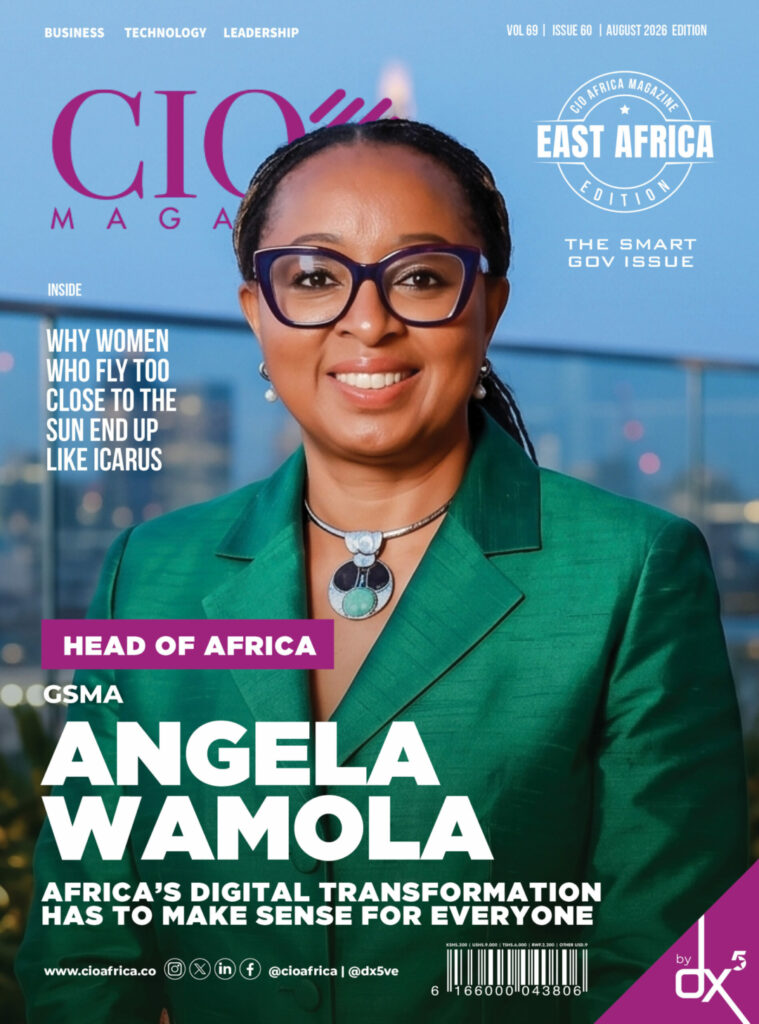
This article was first published in the August 2026 edition of CIO Africa Magazine, East African edition.