
advertisement
Landed, Not Delivered

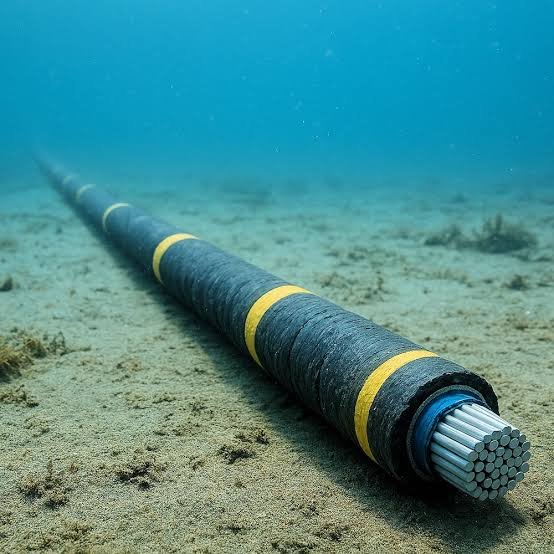
TeleGeography published its latest international bandwidth figures in September. Global capacity stood at 2,259 Tbps in mid-2026, up 23 per cent year on year. Africa was the fastest-growing region, expanding at a compound annual rate of 35 per cent between 2022 and 2026, ahead of Oceania at 25 per cent and every other region.
“Total international bandwidth now stands at an impressive 2,259 Tbps,” wrote Paul Brodsky, the firm’s senior research manager.
By the measure the industry has used for twenty years, Africa is winning. Seventy-seven cable systems were active or under construction at the start of 2025, with Egypt hosting 19 landings and South Africa 11. The Meta-backed 2Africa system was activated in late 2025, with a design capacity of up to 180 Tbps across more than 46 landing points in 33 countries. Google’s Equiano cable runs 15,000 kilometres and has a capacity of 144 Tbps.
advertisement
But once the bandwidth reaches the beach, the numbers change character entirely.
Where it stops
The continent has roughly 2.1 million kilometres of terrestrial fibre, but only about 1.3 million kilometres is fully active.
advertisement
Those figures come from the Africa Broadband Outlook, published by the African Telecommunications Union and Africa Analysis. They describe 2024, the most recent year covered by a comprehensive survey of African terrestrial fibre in the public domain. Around 58,000 kilometres entered service in the twelve months to June 2024. On the same count, close to 800,000 kilometres of built fibre was not fully active.
That is the difference between infrastructure and a functioning network. Cable in a trench earns nothing until it is lit, interconnected and sold. Much of Africa’s fibre remains at the first of those three stages.
The proximity figure is starker. Only about 30 per cent of Africans live within ten kilometres of a fibre node. Fewer than one in 100 have a fixed-line subscription, compared with a global average of 18 per 100. Seychelles, at 27, and Mauritius, at 31, are exceptions; most other African countries are below four. According to a Xalam Analytics assessment, last-mile fibre passes more than 18 million homes and businesses across the continent, concentrated in commercial corridors and major urban centres.
advertisement
Shameel Joosub, chief executive of Vodacom Group, put it plainly at AfricaCom last year. “Africa is still significantly lacking in fibre infrastructure,” he said, arguing that fibre, mobile and satellite networks must work together rather than compete for the same budget.
The same shape, one layer up
Readers of this publication will recognise the pattern. In September, we reported the GSMA’s finding that 92 per cent of Africans live under mobile broadband coverage, while only 36 per cent use mobile internet. That leaves roughly 906 million people covered but offline, compared with 122 million without coverage.
That was the retail layer. This is the layer beneath it, and the pattern repeats: capacity is built but not carried forward, while investment continues to flow towards the parts of the network that already work.
One difference matters. The retail gap is measured. The GSMA publishes figures annually, development institutions cite them and ministers are asked about them. The inland gap has no comparable measure. There is no published index of African backhaul prices, no continental dataset on cross-border transit costs and no requirement for regulators to disclose either.
You can establish in ten seconds how many terabits land at Amanzimtoti. Finding out what it costs to move a gigabit from there to Gaborone requires a procurement process.
That opacity matters because of a comparison often repeated in the wholesale market: backhaul from Lagos to London is said to cost several times less than backhaul from Lagos to Abuja. The claim appears in trade analysis of the middle-mile market, but we could not verify it against operator tariffs because those tariffs are not published. Buyers of capacity do not dispute the direction of the comparison. But nobody can show the working.
Where it bites hardest
Countries without a coastline bear the cost most directly.
Across Africa’s landlocked developing countries, about 25 per cent of people used the internet in 2024, compared with 68 per cent globally, according to ITU figures. Yet 86 per cent of that population lives within reach of a mobile broadband signal. Coverage is widespread. Use remains low.
Landlocked countries reach the sea through their neighbours. Their international capacity is therefore priced by another country’s terrestrial operator, often in markets with limited competition. The six CEMAC states have been building the Central African Backbone since 2007, but progress has been uneven. The World Bank-backed West Africa Regional Communications Infrastructure Programme has also faced disruption in some areas. In Mali, a $117.3 million contract was approved in January 2024 to extend fibre to Mopti, Koro and Timbuktu over 24 months.
The corridors are coming, slowly. In February 2026, Paratus activated a 2,000-kilometre protected fibre route from Mombasa to Goma through Nairobi, Kampala and Kigali, giving eastern Democratic Republic of Congo direct access to Kenyan subsea systems. “By creating a protected route from the coast all the way into Goma,” said Martin Cox, the group’s chief commercial officer, describing the build. Airtel Telesonic is planning an East and Central African backbone with 139 nodes and capacity of up to 38 Tbps. South Sudan licensed Bayobab Infra Solutions in October 2025 to build national and cross-border fibre.
What a landing is worth when the inland network exists
The counter-example is instructive because it shows what works.
An impact assessment of Equiano in South Africa projected that average speeds would rise from 28 Mbps in 2021 to 75 Mbps in 2025, while retail prices would fall by 21 per cent. South Africa has metro fibre, exchange points, data centres and competitive backhaul. The cable landed in a network capable of carrying its capacity, and customers benefited.
That is the argument in one case study. A landing station is a multiplier, not an input. Multiply it by a sparse inland network and the result is still a sparse inland network, albeit one with a very fast edge.
Jean-Philippe Fournier, founder of Spectronite, has argued that high-speed wireless backhaul can be deployed faster and at lower capital cost than trench-and-duct projects. It is one of several approaches being tested, alongside satellite backhaul where terrain or security makes excavation impractical. Amu Maja of Openserve has framed the distinction plainly: in metropolitan areas, the task is scale; in rural and semi-rural areas, it is inclusion. They are different businesses with different economics. Treating them as one is how the middle mile keeps losing the budget argument.
The hub effect compounds
There is a second-order dynamic worth watching.
Capacity concentrates where cables land. Data centres follow capacity because interconnection is the product. Content caches follow data centres, and enterprises follow content. Within a few investment cycles, the coastal city has an ecosystem while the inland capital has a transit bill. The gap widens almost by itself, as each new landing improves the economics of places that already have the strongest connections.
Egypt’s 19 cable landings and South Africa’s 11 are not failures. Hubs are efficient, and both countries have earned their positions. But a growing share of African traffic now passes through a small number of places. That raises questions about resilience as well as equity, as the recent wave of global platform outages has demonstrated.
The risk is not that the hubs exist. It is that the hub becomes the whole plan.
What to watch
Four markers would show whether the middle mile is being treated as seriously as the seabed.
First, whether the African Telecommunications Union publishes an updated terrestrial fibre survey. The sector is still relying on 2024 figures in 2026. Second, whether any African regulator requires the disclosure of wholesale backhaul and transit prices, making the inland gap measurable in the same way as the usage gap. Third, whether retail tariffs in eastern DRC fall now that the Mombasa-Goma route is live. This is the clearest natural experiment available. Finally, whether a major fibre programme reports the number of active kilometres, rather than simply the kilometres laid.
Africa is building international capacity faster than anywhere else on the planet. But the few hundred kilometres between the landing station and the customer remain expensive, and are still waiting for a business case.