
advertisement
2 Microsoft Executives Shaping Africa’s AI Future


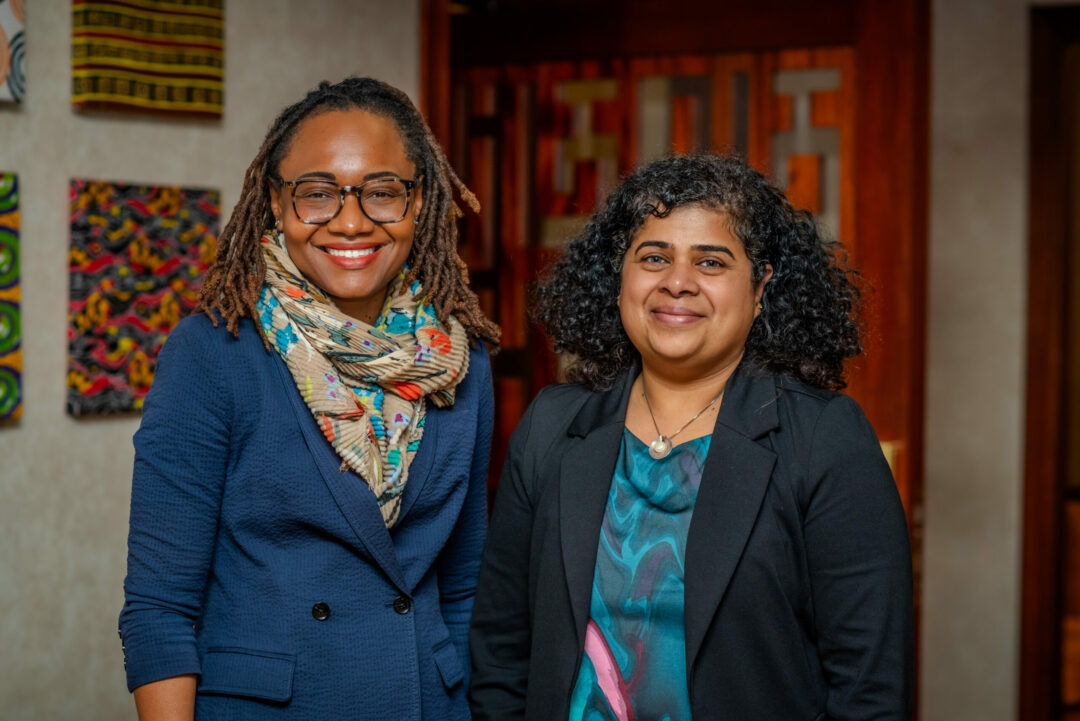
Aarti Borkar, Corporate Vice President, Microsoft Security, Customer Success and Rashida Hodge, Corporate Vice President, Data & AI Customer Success, Microsoft, are impressed. They’ve felt the culture and the ethos of Kenyans, and brushed up against our national pride. It is a beautiful thing because national pride has multiple trajectories depending on the generation you speak to, and of. Unstoppable, too, is our confidence in a growing economy. I love this for them. I meet the pair post a women-in-tech candid conversation where the intersection of femininity and race collide in candid conversation.
I was very excited to do this interview, and I loved your talk. It was very illuminating and authentic – very fresh. You’ve both attained VP status, hitting the pinnacle of corporate leadership in technology. What was the defining moment that shifted your career trajectory? The one that tipped you over or that landed you in this executive role?
Aarti Borkar: There wasn’t one particular moment. It’s a journey that went in different ways, where I seek the next skill I want; something new to learn has driven the job I took next. I also took the hardest job, the one that no one else put their hand up for, to solve a problem that was going to have me run faster and longer, one that I could learn the most from. Then I got addicted to the fact that I was going to take the hardest thing because I learned the most. Learning keeps me excited every day. I don’t think there was a day I said, ‘I want to be an executive.’ It was more of a journey that took me through a variety of interesting places where I continued to learn, then the harder jobs became the bigger jobs, like running a business at a global level, which became an acquisition and running an acquisition team.
advertisement
Rashida Hodge: If I had to pick, a couple of mentors at one point gave me advice to never shy away from a job that was offered because I didn’t know how it would turn out. It changed my behaviour. I looked at every opportunity as something that was going to give me a way to learn something, versus worrying about whether I was going to fail. The minute I changed that, I think the world’s been nicer. I grew up in St. Thomas, a small island in the Virgin Islands. Tech wasn’t something prevalent. That’s not what people did. I learned about it through a book. What I did learn growing up on an island with teenage parents was resilience.
My career path has been about resiliency, how to learn, how to be curious, how to try new things. There’s not one moment. But I think for me, it’s learning over time how to navigate; the learning, the curiosity, owning my vibe and owning my difference so that I can show up confidently, with purpose. My parents also taught me to sit at the dinner table, giving me the script on what to do. It gave me the courage to act as a leader, leading with purpose. The energy I got from my community and that very small village guided me along the way and allowed me to keep going.
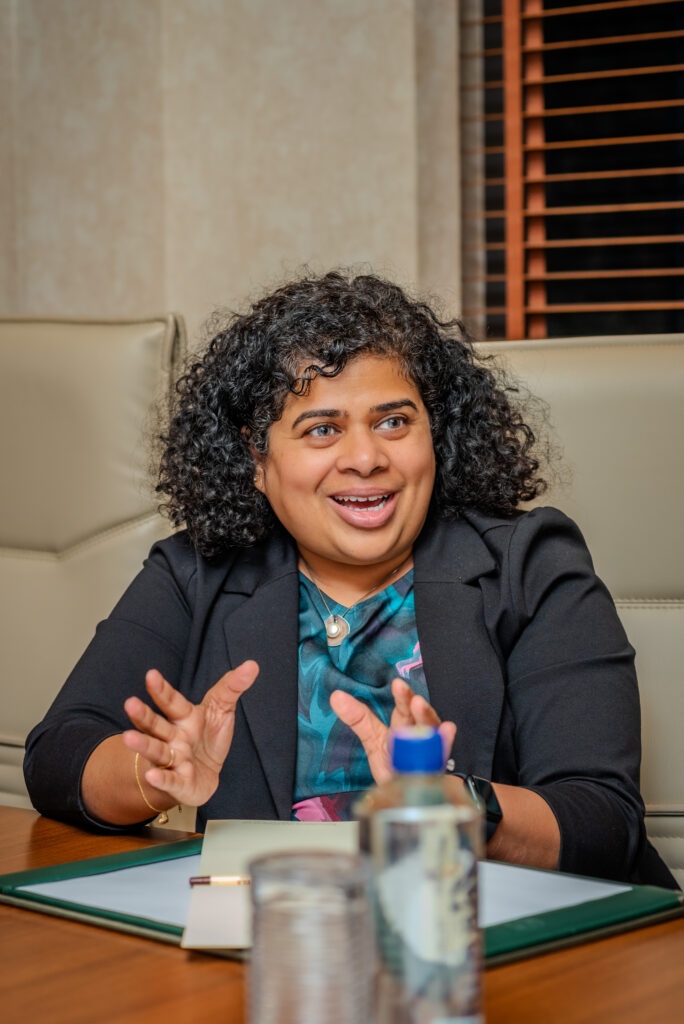
Was there a significant moment where you felt you were hitting certain barriers along your path? Was there an instrumental barrier?
advertisement
Hodge: I always say I suffer from the trifecta of being black, being a woman, and most people thinking I am much younger than I actually am. And what comes with that? You are underestimated. You’re excluded from conversations. But I’ve never seen it as a barrier. I’ve seen it as it’s the reality of the environment and the spaces that I’m in, and how do I, again, build, lead with purpose and authenticity within myself and act with courage. One of the things that motivates me to continue to push forward is showing that someone like me has been able to achieve what I’ve been able to achieve despite the age of my parents and my grandmother being a domestic worker her entire life.
People could look at me today and think I had a privileged life, but I didn’t. My mother didn’t know what an engineer was. I read it in a book – there was no Google – when I was in fifth or sixth grade. I went to her, and I said, I want to be an engineer. She asked, ‘What is that?’ I said, I didn’t know. But in this book, it talked about this person who solved the problem, and they were an engineer. And every opportunity that sort of came my way, I said yes to it. What has defined my leadership and differentiated me is that I said yes to most things people said no to, like going to China. Friends and family didn’t understand why, especially when I said I was going to Slovakia after being at IBM for 20 years and making the shift to Microsoft. They thought I was crazy.
You’ve said yes to a lot of things, Hodge. What do you say no to?
advertisement
Hodge: That’s a good question. I say no to things that are not aligned with my purpose. And where I can make a difference. A big part of my leadership is not just leading with purpose for myself, but leading with purpose with others. I’ve had opportunities that changed my life and gave me access. I want to extend that to others, so I created an endowment in North Carolina. NC State was so defining to my life and my being that I want other kids growing up on 32 square miles that most maps don’t even show it to have the same difference that I’ve been able to have. I’ve been to over 80 countries in the world. I would have never in my life imagined that I would experience and interact with the people that I do today. We talk about how we manifest our dreams. I didn’t even know that was a dream.
What about you, Borkar? Were there any significant barriers in your career, or was the one barrier that you felt was the biggest one you had to overcome?
Borkar: I have a similar story. I’m so much of a technical geek that the thing that I follow, the thing that guides me, is solving the technical problem. I decided people who judged me for being smart weren’t voices worth listening to. It was such an overpowering need to solve complex technical problems that I could drown out the noise.
You could hyper-focus.
Borkar: Yes. I have this ability to drown out the noise. It is an extremely powerful skill. My husband says this about me, that I can sit at the airport with the world moving around me and not care and still solve a complex problem. Most people need quiet to solve a puzzle. I also love to make people smile. I use humour to diffuse tension. I’m not saying I’m a good comic … but I can use humour well enough. It’s one of the techniques I use to get to the problem and solve it. The way I look at it is, if I can diffuse the tension in the room, we can all then solve the problem. And I’m so hyper-focused on it. It’s actually worked well for me pretty much through my career.
As a duo with skills running the gamut from security to data and AI, your roles are pretty complementary. How do you collaborate?
Borkar: Today, innovation, protection and safety are mandatory. You need them for the survival of the enterprises. You need to safely innovate. If people are constantly worried, they aren’t free to innovate the way they need. The two sides need to be in constant collaboration. We are very focused on giving our customers a platform that is secure by default. When we give a customer a solution, it’s a full solution. It has all the pieces that allow them to then focus not on the tech, not on the security protection, but on their business. That’s what they need to focus on because we can help them with the platform to innovate.
Hodge: When speaking to customers and partners, we are really thinking about AI and security as intertwined. The natural thought process is to think of them as distinctly different, but you know, AI is not just about innovation. It’s about responsibility, resiliency, and security. The first principle is to bring innovation. We democratise it because the goal is to be able to bring that to more people, more enterprises. We want to do that in a way that is fundamentally secure and responsible. We’re really trying to reshape the thinking around that.
You mentioned AI democratisation. How does that look for, say, a small business in Nairobi versus a Fortune 500 company?
Hodge: Quite frankly, I don’t see it as different. That’s the beauty of AI. Our mission at Microsoft is how do we empower every person, every organisation to do more. Not every organisation of X size or Y size or displacement on the globe. It’s every organisation, every person. It’s the access and the opportunity.
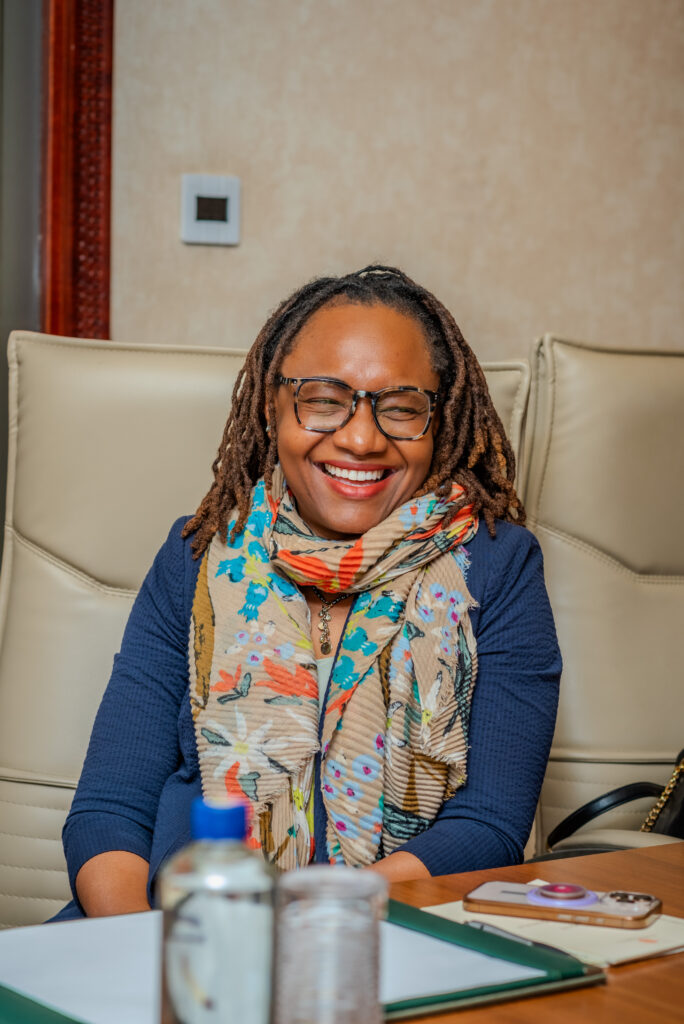
I don’t know if you’ve heard, but according to research revealed a few days back, Kenyans are the top users of ChatGPT globally. We are seeing AI as an opportunity to leapfrog. How are you looking at that as an option for the continent?
Hodge: You’re embracing AI. Champions aren’t made in the ring. We see them in the ring, but they’re made through practice, through perfection and in their training. That Kenyans are the number one users at ChatGPT is fantastic. To drive adoption, you have to have access, and you are taking advantage of the technology. Now the next question becomes, what do you do with that access? How do you then create that into an opportunity? How are you ensuring that you’re using it for good? You’re using it to generate ideas and perspectives to drive change, you know, across your local challenges, so that you can have impact.
From our perspective, even with our work with the Africa Development Centre, it’s not about us bringing tech to the continent. It’s about building tech right with the people, with the enterprises. The fact that you have adopted it is super promising. AI has been around for a long time, but a lot has changed. I call it The ChatGPT moment. Before, people felt they had to have a certain skill, go to a certain university, and that AI was only for these tech giants. Now, my 70-plus-year-old aunts and uncles feel as though they are experts in the technology. That’s how it’s democratised.
You both have customer success in your titles. How would you actually define success? And do you have any specific examples of what success means to you?
Borkar: Look, for me, this is very simple. Customer success is all about how we unlock impact for customers, versus customers just deploying the tech. There’s a lot of technology out there, and our role is really about the word ‘customer success.’ For customers to be able to achieve success, they’ve got to use and adopt the technology. They’ve got to integrate and embed it into their business operations and their workflows to reimagine how they support their customers, how they’re able to compete, how they change their go-to-market, and to grow in the business. It’s really about how we partner with our customers to drive that outcome.
We start off our conversations by learning about the enterprise. What do you do? What are your challenges? What do you want to grow? How do you want to grow your business? What does that mean? Those are the things that we want to be able to help them with. I’m in security, so I’ll add that to it because having security technology is like having a gym membership. It doesn’t do much in your wallet and your back pocket. You kind of have to use it to get to an outcome. Companies want peace of mind as they innovate. Success is that they feel like they are protected. Their people are protected. Being able to give them the right advice and capabilities, and get them to a place where security is an everyday thing. They are safer today than they were yesterday. If customers achieve that and are constantly evolving, then we’ve done our jobs.
When you think about AI and automation, how much does the human touch play when it comes to success in what you do?
Hodge: AI is another arrow in the quiver, another tool in the arsenal of the human to be able to achieve an outcome. And so it’s always going to be a combination. It’s human ingenuity that is now something that can be achieved with the help of AI. It allows you to dream bigger and achieve bigger. Emotion is required to wield the power that AI now provides to create differently. When I have a conversation with a customer about where they’re going, it’s always about the outcome they want to reach. That outcome has to be dreamed up by the team. It has to be a lofty goal that you want to get to. Something you can now dream of with AI by dropping the cat and mouse game of cybersecurity to being able to predict, be prepared differently. AI allows you to do that.
AI skills knowledge, but it doesn’t replace trust. And at the end of the day, relationships are the bridge to adoption. For customers, their challenge is no longer the tech. It’s not the feature or the function. It’s adoption. Change management. The systems are smarter. They are going to allow us to do things better and improved, yes, but they’re also fundamentally human-centred systems.
If you look at 2030, what is the most transformative technology you can see in this space? And how can we work and live with it?
I am super excited by the innovation of agentic workflows. How do you drive a level of autonomy with context? That’s what the agentic workflow does. It’s not about understanding or summarising information. It is executing a process in an autonomous way with context. That is quite revolutionary in terms of where the technology is going. Most importantly, how it’s going to fundamentally change the way we solve problems, how we think about problems, how we think about solving the problem, the way that you describe the problem, but actually think about it autonomously. The thinking at scale isn’t there yet. When the thinking does get scaled from that perspective, as well as the advancement with the technology, I think magic will be made.
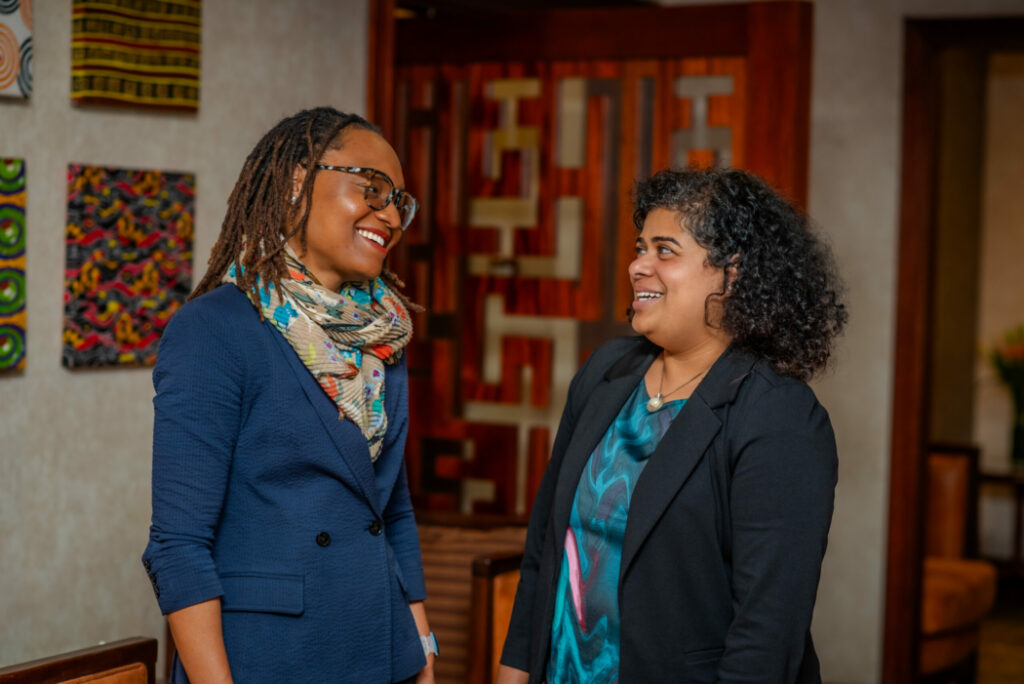
Borkar: Beautiful. Human beings tend to overestimate what technology will do in the short term and underestimate what it’ll do in the long term. We’ll be continually positively surprised with ideas that come out of that. What I’m excited about when you talk about ChatGPT here, and the population being a younger population, is that their minds are free to think of solving problems that all of a sudden they have the tools to solve.
All it takes is a few people realising something annoying a community. It’s how a lot of the apps we use today came about. The speed at which these agents are being built, as an example, is something to build a top. And suddenly you’ve got a large population of developers and non-developers, building modular blocks that can get to the end goal faster. With every evolution of tech, the speed at which we were able to change human life for the better has always been faster. 2030 is five years away. We can change healthcare. We can change education. I grew up in India. I was fortunate enough to be born in a big city with more educational capabilities. I love the fact that we’ve done some amazing work in some developing markets with education and agriculture. You can probably hear the optimism in my voice, but I fundamentally think we can make that available to a much larger population that historically takes very long to get to the technology, and they won’t need to have anything more than their phone to access it.
What’s a woman outside of the tech space who inspires you?
Hodge: Maya Angelou. She was so profound. “We delight in the beauty of the butterfly, but rarely admit the changes it has gone through to achieve that beauty.” That is so true. When people come to me for mentoring today and say, ‘I Googled you, and you did this, and you won this award,’ unfortunately, there’s not a spot on LinkedIn for me to put when I didn’t get the job, when I didn’t get the opportunity. But those things happened.
Maya Angelou really taught me that words matter. She taught me how to talk about myself in a way that exudes power and confidence, and conviction. Sometimes, as women, we don’t talk about ourselves in that way. Presence matters. My mum taught me how to belong in the space that you’re in. And when you are in that space, be there in the truth of who you are. And courage is contagious. I think Maya Angelou is all about courage. So how do you use your words to give you courage? How do you use your presence to give you courage, how to use your presence to give you courage. She’s been extremely inspiring, and I lead with a lot of principles she wrote and talked about regularly.
Borkar, if you had to go back to your 25-year-old self to give her advice, what would you tell her?
Two things. Not to be worried about the future. If there’s one thing I take away, because I always pick the hard things, most people always wonder if I worry. I grew up a worrier who had to take the effort to suppress the worry so as to do what I wanted. I wonder if I was free from that worry – I kept reducing it over time – but how much more could I do if I wasn’t worried?
The other thing I get told about is that I do take risks. I’ve taken a job when I didn’t know half the job because then I had so much to learn. So much excitement, but even then, I grew up in a culture and a community where you took very, very calculated risks. You didn’t just kind of go at it. I wish I had given myself that freedom a little earlier.
And what books are you currently reading?
Borkar: Hidden Potential by Adam Grant. I know I’m late to the book, but I started reading it for a specific reason. My leadership style is looking to find potential in human beings that they can’t see in themselves, because the most powerful thing that was done to me was people who didn’t even know me completely did that for me. The book kind of teaches me new tricks I can use in my mission to unlock potential. I’m still halfway through it, but I have already learned a few tricks that I can’t wait to employ. You leave the world a little bit better than you found it. You leave every room a little bit better than you found it. And if you can unlock potential that people didn’t realise and see they had.
By the way, you’re never late to a book. You find it when you need it.
Borkar: Yeah, I agree. That’s a good point.
Rashida, what are you reading?
The First 90 Days by Michael D. Watkins. When I first became an executive at IBM, a mentor gave me that book. I actually gave it to all the managers in my team to read it as well, because it’s important from a leadership perspective to always handle yourself. To always remind yourself that some things can be learned, and you don’t know it all. I wanted to reground myself in the principles of ‘what should I keep top of mind as I take on a new team?’ New people are now reporting into my organisation. What are the things I should think about in terms of making sure that we have a strong organisational capability? Hopefully, all my managers are reading it too.
What do you do outside of work? For fun?
Bortak: I love to travel and paint. When I’ve got short periods of time to do something fun, I paint oil on canvas. It is my happy place. I can also zone out because I’m looking at the pictures. I am so inspired by the art in the room and the choice of colour and coordination depicting culture. My husband and I have our favourite thing to do, which is to be in the bush in remote corners doing things no one can. We drove through Namibia for two weeks last year. I love to travel. I think it’s just the bug in me coming from a small place. I knew there was a bigger world out there, so I’ve been trying to explore it.
Hodge: I am West Indian, and we culturally have The Carnival. And no one ever believes I participate, thinking, but you’re an executive! It is my favourite time of year. We have bands on the street. You wear whatever you want. And you just dance in the street.
That Carnival is on my to-do list.
Hodge: You have to do it. We dance in the street from four in the morning until noon. It is like the best therapy for me ever. My culture is in my blood. And I’m a big lover of music. When I wake up in the morning, I have a shower playlist I put on every day as I get ready for my meetings. I call it my hype list. I play it to get me ready for the day, and it’s a mood shifter regardless of your mood. I’m very cognizant of what I listen to, what motivates me to get me in the right spirit to lead with purpose.
Who’s on your playlist?
Afro beats, but I listen to all types of stuff.