
advertisement
CIO100: A Look At The 5% Of Successful AI Projects Vs The Unsuccessful 95%


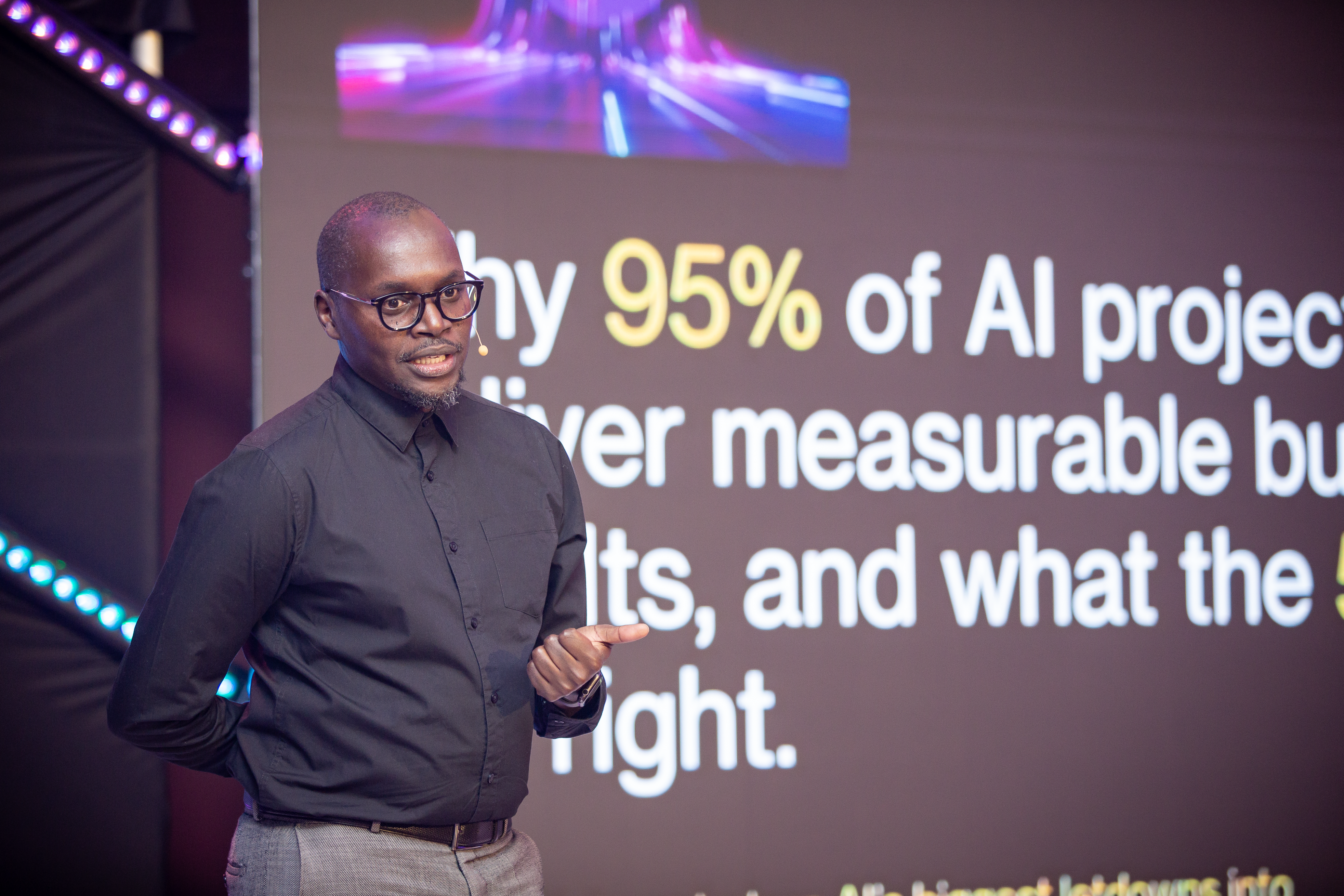
A 2025 study by MIT titled ‘State of AI in Business2025, revealed that 95% of AI projects fail, further showing that billions of dollars invested in enterprise GenAI pilots are yielding no results.
While most people who came across this report looked at it as losses being made in AI investments, few people looked at the 5% that got it right. This was the topic of discussion at one of the presentations at the 17th edition of the CIO100 Symposium and Awards.
Timothy Laku, Fractional CIO/CTO, Impact Organizations, looked at case study examples of AI projects in Africa that failed and those that succeeded. Laku compared the 95% that failed with the 5% that succeeded and talked on the AI friction that MIT also highlighted in its study.
advertisement
In his presentation, Laku shared a little survey he did with 100 CIOs asking them what they are looking for before starting an AI Project. As per the findings he shared, a majority of the respondents didn’t know where to start (55%), while others said they would look at the budget first (33%), while others said they would look at their skill-set first (6%).
Laku further gave examples of failed AI projects in Africa while giving a close eye to why they may have not succeeded. The bottom-line according to him is the impact. He advised CIOs to look at the impact that project will have to a life, and individual, or a customer. He said that the impact needs to be the motivation for that project before looking at other factors as well.
An example presented of a failed project was what most banks have tried in Africa, to automate credit scoring models using AI. According to Laku, 92% of the models delivered biases based on the biased data they were being fed. It became difficult for this models to look determine credit scores for all customers fairly.
advertisement
Another example of a failed AI project that Laku gave was what has been tried by many cities around Africa with no success, automating traffic lights. This projects have been promising to reduce traffic congestion in major African cities with little success. According to Laku, these projects fail because of lack of maintenance and also using low quality infrastructure to roll them out.
The final example Laku gave of a failed project was government chatbots that were aim to help governments serve its citizens seamlessly. Laku said that these projects’ main undoing was lack of ownership. He said that the governments want to own the system but the real owners need to be the citizens.
Similarly, Laku gave examples of AI projects in Africa that have been a complete success, the 5%. One classic example was the deployment of Zipline drones to aid in medical deliveries in Rwanda. Kigali, the capital, has a very hilly terrain making it difficult for medical deliveries to rural areas. The reason why this succeeded, according to Laku is because the government worked in unison with the provider (Zipline).
advertisement
The second successful project example given by Laku was South Africa’s AI for tax compliance. In this project, South African Revenue Services (SARS) used AI models to flag suspicious declarations. The reason for success in this project, according to Laku was that risk and audit worked together and everything was in sync.
The last successful project example was for Nigeria’s Kuda Bank which used AI to build a fraud detection engine. This project was hugely successful because because the foundation of it was around data engineering where the data had already been set. They were also doing retraining of the models because the fraud also keeps evolving.
In conclusion, Laku urged CIOs in the room to focus on solving one problem that is mission critical, rather than starting too many projects at the same time and not realizing the success of any.